September 25, 2009

LAZY CHOCOLATE CHANTILLY TART

tartelettes-choco-chantilly

Easy to make chocolate whipped-cream tartlets are quickly gobbled up

Jet-lagged and worn out from a summer of planes, trains, and automobiles, there was one thing on my mind the other day… le chocolat. Sweet and dark.  Chocolate whipped-cream (chantilly) is one of the most simple desserts to make, and finishes much like a chocolate mousse. You can use it simply to decorate or cover a cake, or you can do as I did: pipe little rosaces onto pre-cooked sugar pastry shells, take a picture, and gobble them up!

Recipe for chocolate whipped-cream (chantilly):

cold heavy whipping cream
your favorite best-quality chocolate (I used dark chocolate at 70%)

Refrigerate a glass or metal mixing bowl.

Melt the chocolate over a double boiler until just melted. Allow to cool a little.

Using an electric beater, whip the cream to medium peaks. It is important not to over-whip the cream, or you will end up with butter.

Pour the melted chocolate into the whipped cream, mixing quickly. Use as you wish and keep refrigerated.

Yum! Yum!

August 12, 2009

ROASTED EGGPLANT & TUNA WRAP

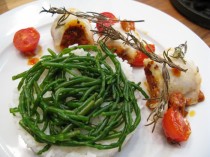
eggplant-thon-1Little packets of roasted eggplant and tuna

Summer is in full blast. The thundering roar of the sun pours into the Mediterranean, sea and soil. Tomatoes, eggplant, melons, peaches, nectarines, plums, green beans, garlic, and zucchini ripen and make their ways to the plate with a splash of olive oil and a dash of pepper.

This is the kind of cooking that must be accompanied by a crusty baguette. Purpose: soaking up the delicious juices and olive oil that rest on your plate just when you think you have finished.

eggplant-thon-2Serve on a bed of fresh green beans sautéed with tomatos, olives, onions and garlic

Recipe for roasted eggplant and tuna on a bed of green bean sauté:

This is a basic explication open to your own creativity. Don’t go overboard with ingredients. Keep it simple.

You will need:

onion
garlic
tomato
eggplant
green beans
canned tuna
capers
olive oil
salt
pepper
fresh basil leaves
…..

Mix the tuna with a teaspoon of capers, some olive oil, salt or soy sauce, and pepper to taste. Set aside or in the fridge.

Put the thinly sliced onions in a frying pan with a good amount of oil and a little salt over low heat and allow to caramelize, partially covered, for about 15 minutes, stirring from time to time.

Put the green beans in a frying pan with a little water and oil. Cover and cook just until the color starts to change. Add the caramelized onions, the sliced tomatoes, and thinly sliced or pressed garlic. Cook for another minute or two. Season to taste.

Thinly slice the eggplant lengthwise and sprinkle with olive oil and salt. Roast in the oven at 350°F flipping once and taking care not to let it burn.

When the eggplant is cooked, take two strips and place on a plate like a cross. Place a nice spoonful of tuna in the middle and fold in the sides to close. Serve on or with the green beans.

Don’t forget a basket of bread on the table.

This dish is nice with a cool glass of rosé on the veranda.


June 25, 2009

LEMON MERINGUE TART

tarte-citron1Lemon meringue tart the way I like it

So they say that meringue on your lemons is no longer in vogue. I say smoof.  Meringue may be a little too sweet, a little too puffy, a little too creamy… is your mouth watering yet?  Vogue or not, it has its place.  Just a dab is the perfect counter to the dense acidity of a good lemon cream.

WARNING: THIS TART IS STILL IN THE PROCESS OF PERFECTION…  More than a year ago, I posted a lemon meringue tart, following the recipe of the first dessert that I made for this goofy French guy who somehow convinced me to move with him to France. (Ok, so maybe it didn’t take too much convincing…)  As you might notice, pastry school has changed my style, and I would say it’s for the best.

tarte-citron2

A slice of lemon meringue pie

This tart was made with an oven-baked lemon custard which is quite nice even without the meringue.  For the record, I have since enjoyed a recipe cooked by the double-boiler method.  The result is a very dense and extra creamy custard. The only hazard: it’s a little more tricky to pull off, and you could end up with a yucky lemon omelette in the place of a creamy lemon custard if you don’t watch out.

On a side note, I’m off for adventures in Lithuania for the next few weeks, so I’ll be back in a month or so.

Recipe for a lemon meringue tart with a creamier custard:

18 cm tart

Pâte sucrée (Sweet shortcrust pastry)

-125 g flour
-50 g powdered sugar
-50 g butter (just a little softened)
-half an egg
-a pinch of salt
Note: I recommend doubling this recipe and freezing half of it so you can just use a whole egg. To use the frozen pastry, just place in the fridge to defrost a day in advance.

Cream together the powdered sugar, butter, and salt. You can do this with your hands. Have a spatula ready to clean your hands of dough.

When you have a smooth cream, add the egg and mix together. It’s normal that the egg doesn’t mix well with the butter and sugar cream, but do your best. It helps to have the egg at about the same temperature as the cream.

When your egg is well mixed with your butter and sugar, add the flour and mix with your hands just until you have a homogenous dough.  Pastry chefs use a technique called “fraser.”  This simply means that you take the lump of dough and squash it against the countertop using the base of your hand, until the flour is mixed in. The trick is to avoid working the dough too much, which will give you a dough that shrinks in the oven.

Flatten the dough a little, taking care that the edges don’t start to crack. Wrap in plastic wrap and refridgerate for at least 1 hour or overnight.

Remove dough and roll into a circle, again watching out not to crack the edges. Roll the dough onto your rolling pin and push into your tart tin. If you are making a tart with an oven baked custard, you can fill with custard and cook. If you are making a tart with a double-boiled custard, place a layer of waxed paper in the tart and fill with baking beans. Then cook for about 30 minutes at 180°C or 350°F.

Lemon Custard

18 cm tart

-60 g fresh squeezed lemon juice
-73 g sugar
-120 g eggs (about 2 large eggs or 3 small eggs)
- 60 g butter (unsalted)

Place the lemon juice, sugar, and eggs in a double boiler and cook, stirring constantly until the mixture has thickened enough to coat the back of a spoon, or until it has reached 83°C. Transfer to a bowl and allow to cool!

When it is still just a little warm, add the butter in small pieces, stirring until incorporated. Now you can pour into your pre-cooked pastry crust and refrigerate for at least 3 hours before decorating with meringue and serving.

Recipe for italian meringue

Recipe for oven baked lemon custard

June 18, 2009

THE STORY OF BREAD

pain-1Chestnut bread sings like a crackling fire fresh out of the oven

Think of the ancient Greeks, middle eastern peoples, the Jews, and the Egyptians as pioneers in the art of baking.  Later during the Dark Ages a thick slice of bread accompanied daily meals. Later still, Charlemagne proclaims, “Let the number of bakers be always complete, and the place where they work always kept neat and clean.”*

You might wonder why a someone living in France would be inclined to make his own bread, what with fresh baguettes for sell on every other street corner.  The fact is that most of it is lacking in quality. It’s puffy, bland, and goes stale very quickly.  Many say that it’s difficult to digest. Already in 1982 a national survey suggested that 75% of consumers were unhappy with the quality of their bread.*  These same consumers must take partial blame for the bad quality of their bread as consumers are worshippers of low prices. Base ingredients must be cheap and time spent in preparation kept at a minimum to maintain low prices.  Bakers advance with the same speed as the rest of the world.  Kneading is not done by hand but by machines that mix faster and faster in order to get the job done more quickly. Most bakeries use pre-prepared flours which contain a number of additives such as ascorbic acid, soya lecithin, preservaties and bleaching agents, aiming to make standard fool-proof breads that don’t change with humidity or seasons.  The average baker cannot be called a craftsman, but rather, a small industrialist or worker.  Don’t get me wrong- I don’t want to glorify the past just for the sake of it. Certainly innovation is helpful and even necessary, but when do we say when? We end up with bread that has been made according to society’s standards: cost-efficient, regular, and physically attractive. The perfect product. Best eaten in a mad frenzy on your way to work so that you don’t think too much about the taste or texture.  Oddly enough, the few bakers who refuse to make bad bread, privileging high quality ingredients and quality-seeking techniques, make their fortunes. A number of bakeries are even starting to offer breads made with traditional leaven (sourdough starter) as consumers start demanding better bread.  Gladly, they have economic interest to offer good bread, but a cultural interest as well.

In any case, Bastien and I got bored with the local bakers and decided to test our own bread, made traditionally with homemade “yeast” called leaven or sourdough starter. After almost a year of weekly bread baking (and kneading and shaping, and sometimes pleading on his knees for it to rise…), Bastien is starting to get the hang of it and I decided that we were ready to share.

SteveFred, meet Steve (our leaven)

Steve is our leaven and lives in a glass jar in the fridge.  Once a week he spends the day out of the fridge to warm up and get bubbly. He doesn’t cause too much trouble, and is very quiet… too quiet sometimes. About two months ago someone closed his lid and he almost suffocated to death. You see, Steve needs oxygen like the rest of us, so we don’t close his jar completly. Luckily we discovered the shut lid a week later and spent the next month nursing him back to health. We are happy to announce that he’s been back to his old self lately and seems to love the new summer weather.

A fashion show featuring a few other breads that we make with our Steve:

pain-3Organic wheat bread

pain-2Round loaf and baguette

pain-4Round loaves

pain-figueFig and walnut einkorn wheat bread

Pictured to the left is about 300 grams of dough flattened with 3 dried figs and 2 handfuls of walnuts.

Recipe for homemade leaven bread:

Before jumping in, know that it will probably take a little time and a little practice to get your bread the way you like it, but homemade bread is worth it. Here are the basic steps with a basic wheat flour.

You will need:

-a pizza stone (to place on the lowest rack of your oven facilitating a better distribution of heat)
-300 g leaven (either you have one, you can purchase one online, get some from a friend, or better yet, make your own)
-15 g natural sea salt
-150 g mineral water plus at least 400 g mineral or filtered water (we use a Brita filter)
-150 g rye flour for refreshing the leaven
-900 g flour
-some cornmeal to create a nonstick surface on your pizza stone

Step 1

The morning before, take your leaven out of the fridge.

Step 2

Before you go to bed, refresh the leaven.  In a large bowl, mix it with 150 g of rye flour and 150 g of water. We use rye flour because Steve (our leaven) loves it… (leaven works best with rye flour). Cover the bowl with a kitchen towel and leave it on the counter for the night, away from drafts.

pain-petrissage

Step 3: pictured above

In the morning, or 12 hours later, check that your leaven is bubbly. This means it’s active and ready to use.  Put a few spoonfuls of leaven back in your jar and put it in the fridge for the next batch.

Heat the water with the salt on the stove until lukewarm. Using your hand, mix the leaven with the lukewarm saltwater. Gradually add the flour, kneading until all the flour is moist and you have a nice moist ball that springs back a little when poked, as pictured above. If it’s sticky, sprinkle the dough ball with flour for easier handling, but don’t knead more flour into your dough.

Cover the surface with a cloth allowing no air holes and allow to rise in a warm place for about 2 hours, until the ball has doubled in volume.

pain-formingStep 4: pictured above left

When dough has risen, slice the dough into equal or less equal parts, as you prefer. We usually make small loaves at about 400g the loaf. Quickly form each part into a ball and allow to rest for about 5 minutes on a lightly floured surface.

Step 5: pictured above right

Take a ball and flatten it using to palm of your hand. Fold an edge about one third of the way towards the center. Fold in again, and then once more and press the dough together to form the “key” (or the spot where the dough is pressed back together). It must be well sealed or it risks opening up in the oven.

pain-risingStep 6: pictured above

Sprinkle a little flour on a kitchen towel and place each loaf as pictured above. Cover with another kitchen towel (to prevent a crust from forming) and leave to rise in a warm draft-free place for about and hour and a half, or until the bread has risen as pictured above and to the right.

Step 7

When dough has risen again, put the pizza stone on the bottom rack of the oven and preheat the oven to 240°C or 450°F.

When the oven is ready, remove the pizza stone and sprinkle it with cornmeal. Carefully place each loaf on the stone. Quickly score the loaves with a razor blade or a sharp knife.

Prepare a half a glass of water. Open the oven and put the pizza stone with the bread back on the lowest rack. Quickly pour the water into the bottom of the oven and shut the oven door. The steam will help the crust develope a nice color during cooking.

Bake for about 35 minutes.

To tell when your bread is done. Take a loaf and knock on the bottom as if knocking on a door. If it sounds hollow, it’s done! If not, put it back in the oven for a few more minutes and try again.

When it’s done, place the loaves on a cooling rack and allow to cool for at least an hour. Enjoy!

*Information from the fabulous book History of Food by Maguelonne Toussaint-Samat

May 22, 2009

CARAMELIZED TARTE À L’OIGNON

tarte-onion

La tarte à l’oignon, up close and rustic

The house smelled absolutely edible the evening I made this tart. Onions and heat are a divine pair for a few hungry people at the end of the day, especially when those onions are ever so patiently caramelized until translucent and melted.  One bite of a caramelized onion tart might draw in all your senses leaving you with the sound of “mmm.”

Caramelizing does take patience, but it’s simple to do if you have a little olive oil, low, low heat, and onions. Stir them from time to time, partially cover the pan if need-be. Do something else while they are cooking, or you will get impatient, turn up the heat, and end up with burned and crunchy onions, as I always did in the past. As long as the heat is really low, there is not much risk of burning.  A pâte brisée (crust) is also simple to make by hand and can be made ahead of time, or even frozen. I simply garnished with fresh thyme, which zipped sprucely on the tongue and made a lovely color contrast.

tarte-onion-1

A slice of onion tart waiting to be devoured

The Recipe for an Onion Tart:

1 pâte brisée (I promise to post a good explanation for basic recipes very soon! And for anyone waiting for my pastry cream recipe to finish the Napoleon, I’ve got it. I just need to write out the step-by-step directions.)
about 6-8 medium sized onions, sliced very thinly*
olive oil
fresh thyme for garnish
*You can use onions of any size, using more or less to have enough to garnish your tart. I would love to try this with some big and sweet Vidalia onions next time I’m in the states.

….

In a large nonstick pan on the lowest heat, add a few good tablespoons of oil. Don’t be stingy or the onions don’t cook quite right. Stir from time to time, and if you get impatient or the onions seem to be drying out, partially cover the pan, but don’t turn up the heat!

Roll out the pâte brisée and shape or cut into a circle. Place onto a baking sheet by rolling the dough around your rolling-pin, as if you were rolling up a poster, then unroll it onto the baking sheet. I have nonstick baking sheets and don’t need to oil them, but if you are worried about sticking, oil the baking sheet just a little. Place in the fridge to keep cool. If you are working in a hot space, work quickly, or the butter in the dough beings to melt making your dough difficult to tinker with.

When your onions are nicely caramelized, remove from heat and allow to cool a little while you preheat the oven to about 375°F or 200°C. When the oven is ready, remove the tart crust from the fridge and evenly spread the onions across the surface, leaving a little border. Fold the border over to create the edge of the tart and place in the oven, near the bottom. I place it on a pizza stone. You want the crust to cook, but you don’t want the onions to blacken to cinders.

Cooking time depends much on your oven. I would say about 30 minutes. Check by looking at the color of the bottom of the tart, manipulating with care of course. A pâte brisée is fragile, especially when hot.  If a good golden-brown color looks back at you and it looks yummy, go for it. If it’s still white, but your onions are darkening, cover them with a little aluminium foil while the bottom finishes cooking.

Serve warm with a big green salad. If it’s summer time, this works with a cool unpretentious (or slightly pretentious if you prefer) glass of rosé.